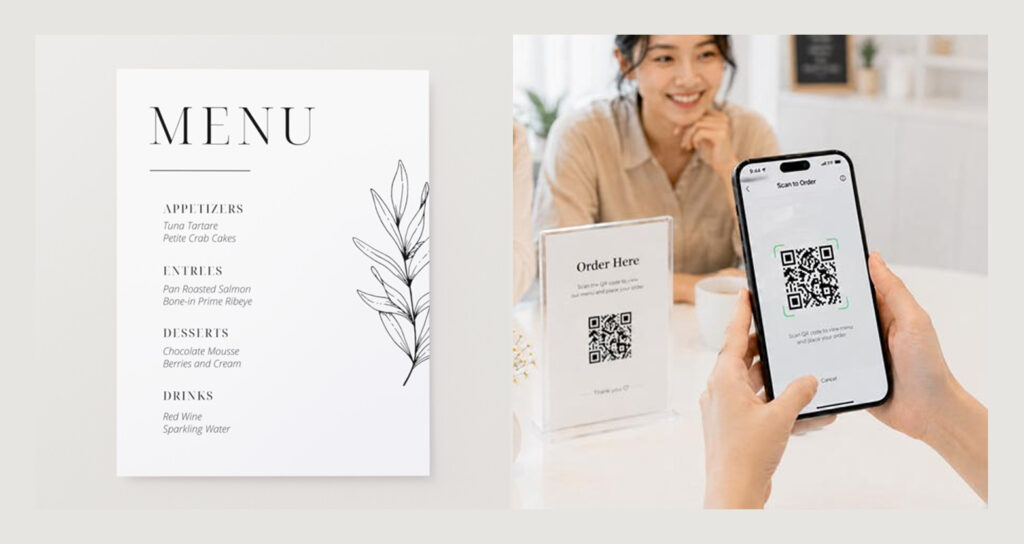
Many restaurant owners believe that offering more dishes will attract more customers. It seems logical: the more choices people have, the more likely they are to find something they like. In reality, however, an oversized menu often creates more problems than opportunities.
A simple, well-designed menu is one of the most powerful tools for increasing profitability, improving service speed, and delivering a better customer experience.
Too Many Choices Create Decision Fatigue
Psychologists have long studied a phenomenon known as decision fatigue. When customers are presented with dozens or even hundreds of menu items, they spend more time deciding and often feel less confident about their choice.
A focused menu allows guests to make decisions more quickly and enjoy their dining experience instead of feeling overwhelmed.
For restaurants that use QR code menus, this becomes even more important. Mobile screens display limited information at a time, so shorter categories and fewer items help customers navigate naturally.
A Smaller Menu Improves Food Quality
Every additional dish requires ingredients, preparation procedures, staff training, and inventory management.
As the menu grows, restaurants often experience:
- Higher food waste
- More expired ingredients
- Longer preparation times
- Increased kitchen complexity
- Greater chance of cooking mistakes
By concentrating on fewer dishes, chefs can perfect each recipe and maintain consistent quality.
Customers remember excellent signature dishes—not endless lists of average ones.
Inventory Becomes Easier to Manage
Food inventory is one of the biggest hidden costs in the restaurant industry.
A large menu usually means purchasing many different ingredients, some of which are used only occasionally. This increases storage requirements and raises the risk of spoilage.
A streamlined menu allows ingredients to be shared across multiple dishes, reducing waste while simplifying purchasing decisions.
For example, a grilled chicken breast can appear in salads, sandwiches, pasta, and rice bowls without requiring separate inventory.
Faster Kitchen Operations
Kitchen efficiency directly affects customer satisfaction.
When cooks only need to master a carefully selected menu, preparation becomes faster and more consistent. During busy hours, this can significantly reduce ticket times and improve table turnover.
A kitchen that handles 40 well-designed dishes will almost always outperform one trying to execute 120 different recipes.
Better Profit Margins
Not every menu item contributes equally to profit.
Many restaurants discover that only a small percentage of dishes generate most of their revenue, while numerous low-selling items consume inventory and kitchen resources.
Regularly reviewing sales reports helps identify:
- Best-selling dishes
- Highest-profit items
- Low-performing menu items
- Seasonal favorites
Removing weak performers allows restaurants to focus marketing efforts on dishes that customers genuinely love.
Customers Return for Signature Dishes
People rarely recommend a restaurant by saying,
“They have 150 different menu items.”
Instead, they say:
“You have to try their grilled salmon.”
or
“Their handmade pizza is incredible.”
Signature dishes build brand identity and make restaurants memorable.
A clear culinary identity is often more valuable than unlimited variety.
Review Your Menu Regularly
A menu should never remain unchanged for years.
Every few months, restaurant owners should analyze sales data and ask questions such as:
- Which dishes sell consistently?
- Which items have the highest profit margins?
- Which dishes receive customer compliments?
- Which items are rarely ordered?
- Are there ingredients causing unnecessary waste?
Small improvements over time often produce significant long-term gains.
Final Thoughts
Success in the restaurant business isn’t about offering the biggest menu.
It’s about offering the right menu.
A carefully curated selection of high-quality dishes helps restaurants reduce costs, improve consistency, speed up service, and create a memorable dining experience.
In many cases, removing menu items is one of the simplest—and most profitable—business decisions a restaurant owner can make.